
What Are the Top Types of Manufacturing Robots?
Manufacturing robots are no longer limited to large automotive plants. They now weld steel frames, place tiny circuit components, inspect bottle caps, and move cartons across warehouses. The International Federation of Robotics (IFR) reported 541,302 industrial robot installations worldwide in 2023. That figure shows strong demand, but it does not identify the best robot for every factory.
Different robot types solve different production problems. Articulated robots provide broad movement and handle welding, painting, and assembly. SCARA robots offer fast, precise horizontal motion for electronics and packaging. Delta robots can pick lightweight products at remarkable speed. Cartesian robots suit structured workspaces, such as CNC loading and 3D movement along linear axes. Collaborative robots, or cobots, support workers near shared work areas, although their safety depends on proper risk assessment and application design.
There is no universal winner.
This guide compares the top types of manufacturing robots by reach, payload, speed, flexibility, and installation demands. IFR’s World Robotics 2024 report provides valuable market context, while standards such as ISO 10218 and ISO/TS 15066 help frame industrial and collaborative robot safety. Still, published specifications can look cleaner than factory reality. A robot may achieve excellent cycle times in a demonstration, then struggle with glare, dust, changing product sizes, or poorly positioned parts. Careful testing matters. Manufacturers should examine total cost, operator training, maintenance access, integration complexity, and measurable production results before choosing a system.
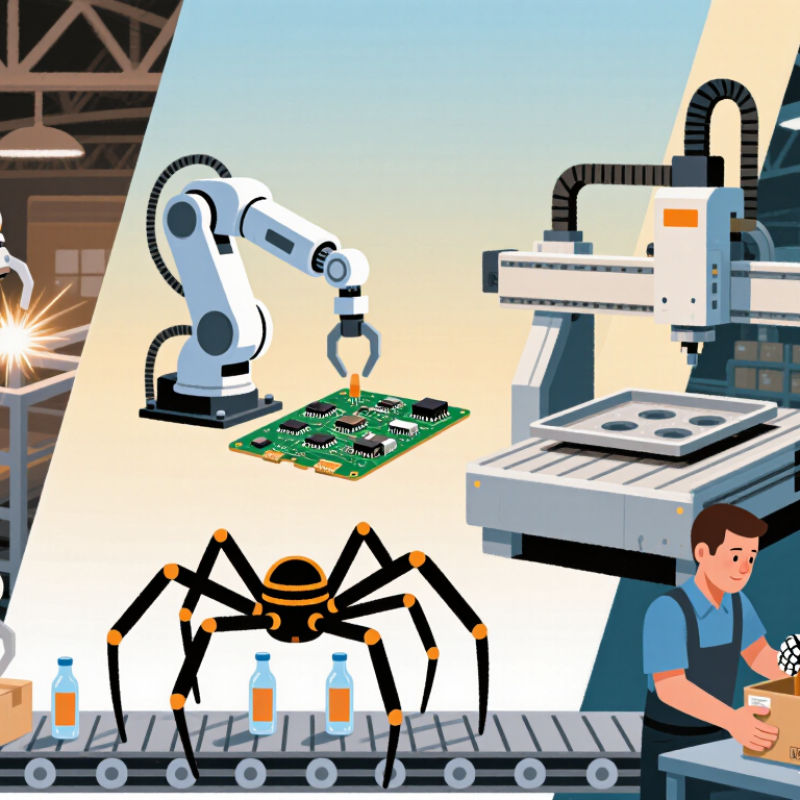
Articulated Robots: Six-Axis Flexibility Across Manufacturing Applications
Articulated Robots: Six-Axis Flexibility Across Manufacturing Applications
In a production cell, an articulated robot moves like a human arm with engineered repeatability. Six powered joints control reach, height, rotation, and tool angle. That range suits welding, machine tending, painting, assembly, and material handling. A technician can guide the arm around a fixture, then approach a part from the side. Small angle changes matter. They reduce awkward tool paths and unnecessary repositioning.
The real advantage is adaptability. A six-axis arm can keep a gripper level while moving through a curved path. It can also tilt a welding torch, align fasteners, or present parts to inspection cameras. Payload, reach, cycle time, and wrist torque must match the application. A robot that is too small may struggle with vibration. One that is too large may waste floor space and energy. Cell layout deserves careful measurement.
Reliable deployment depends on more than motion. Engineers validate guarding, emergency stops, tooling, cable routing, and maintenance access before production begins. In practice, calibration drift can appear after a collision or fixture change. That detail is easy to overlook. Regular checks improve accuracy, but they do not replace skilled supervision. Some applications also need force sensing or vision because parts rarely arrive perfectly. A six-axis robot offers flexibility, not judgment. Its performance still depends on thoughtful programming, stable fixtures, and operators willing to question an imperfect process.
| Manufacturing Application | Typical Six-Axis Robot Configuration | Typical Payload Range | Typical Reach Range | Key Motion Advantage | Common End-of-Arm Tool | Typical Production Requirements | Primary Benefits |
|---|---|---|---|---|---|---|---|
| Arc Welding | Medium-payload articulated robot with an integrated welding package | 6–20 kg | 1.4–2.0 m | Positions the welding torch at multiple angles around complex joints | Gas-metal arc welding torch, wire feeder, and torch-cleaning unit | Stable fixtures, controlled travel speed, repeatable torch angle, and suitable ventilation | Consistent weld paths, improved operator safety, and reduced exposure to heat and fumes |
| Spot Welding | High-payload articulated robot designed for welding-gun inertia | 80–250 kg | 2.0–3.0 m | Reaches opposing sides of vehicle or sheet-metal assemblies with flexible wrist orientation | Servo-controlled spot-welding gun | High repeatability, synchronized welding controls, rigid fixtures, and adequate floor space | Fast access to multiple weld points and repeatable weld pressure and timing |
| Material Handling | Medium- or high-payload six-axis robot selected according to part mass and inertia | 10–250 kg | 1.5–3.2 m | Moves parts through non-linear paths and rotates them for downstream operations | Two-jaw gripper, magnetic gripper, vacuum gripper, or custom tooling | Defined payload center of gravity, reliable part detection, and coordinated conveyor or machine signals | Flexible part transfer, reduced manual lifting, and easy adaptation to varied layouts |
| Machine Tending | Compact or medium-payload articulated robot with guarded cell integration | 5–50 kg | 1.0–2.2 m | Loads and unloads machines from different orientations while avoiding fixtures and doors | Part gripper, chuck-loading gripper, or dual gripper | Accurate handoff, machine interface signals, chip and coolant management, and safety interlocks | Improved machine utilization, shorter handling time, and reduced exposure to machining hazards |
| Assembly | Small- or medium-payload articulated robot with high repeatability | 2–20 kg | 0.7–1.8 m | Adjusts component orientation across several axes for insertion, fastening, or joining | Parallel gripper, adaptive gripper, screwdriver, or press-fit tool | Part presentation, force or torque monitoring when needed, and accurate fixture design | Supports mixed assembly sequences and reduces repetitive manual operations |
| Painting and Dispensing | Medium-payload articulated robot with process-specific protection and control | 5–25 kg | 1.5–2.5 m | Maintains tool angle and stand-off distance around three-dimensional surfaces | Spray applicator, sealant nozzle, adhesive dispenser, or metering valve | Controlled airflow, material supply, path programming, and appropriate hazardous-area protection | Uniform coating or bead quality, lower material waste, and repeatable coverage |
| Packaging and Palletizing | Medium- or high-payload articulated robot with optimized reach and cycle motion | 20–250 kg | 1.8–3.2 m | Rotates products and cases into different orientations for stacking patterns | Vacuum array, clamp gripper, or layer-handling tooling | Predictable product flow, pallet pattern control, conveyor synchronization, and load stability | Flexible format changes, consistent stacking, and reduced manual handling |
| Cutting, Trimming, and Routing | Medium-payload articulated robot with rigid tooling and process monitoring | 10–60 kg | 1.5–2.5 m | Follows complex three-dimensional contours and changes tool orientation continuously | Router, saw, water-jet head, laser head, or trimming spindle | Tool stiffness, dust or debris extraction, accurate calibration, and appropriate guarding | Processes complex geometries and reduces the need for dedicated hard tooling |
| Inspection and Quality Testing | Small- or medium-payload articulated robot paired with sensors or vision equipment | 3–30 kg | 0.8–2.0 m | Moves cameras, probes, or gauges around difficult-to-access surfaces | Industrial camera, laser scanner, tactile probe, or measurement gauge | Stable lighting, calibrated reference points, controlled speed, and data traceability | Repeatable inspection paths and access to multiple surfaces without relocating the part |
| Typical Six-Axis Robot Characteristics | Six rotary joints: base, shoulder, elbow, and three wrist axes | Approximately 2–250 kg | Approximately 0.5–3.5 m | Provides three-dimensional positioning plus roll, pitch, and yaw orientation | Application-specific gripper, tool, sensor, or process head | Payload, reach, repeatability, cycle time, safety controls, and integration requirements must be matched to the process | Broad application flexibility, compact cell layouts, and access to complex workpieces |
Related Posts
-
10 Best Assembly Robots for Efficient Manufacturing Solutions?
-
Who Are the Top Robotic Systems Manufacturers in China?
-

How to Choose the Best Robotic Solutions for Your Business?
-
Top 10 Assembly Robots for Efficient Manufacturing Solutions?
-
2026 How to Build a Robot Machine for Home Automation?
-

Top Robot Machine Innovations Transforming Our Future?