Accordian Closable

Top 10 Welded Steel Pipe Manufacturers Worldwide

Welded Steel Pipe supports essential infrastructure, including water networks, energy facilities, bridges, and industrial plants. Its performance depends on more than diameter and wall thickness. Welding quality, steel grade, corrosion protection, dimensional accuracy, and testing records all matter in demanding projects.

This guide introduces ten leading welded steel pipe manufacturers worldwide. The selection considers production capacity, manufacturing experience, international reach, quality systems, and evidence of dependable delivery. It also examines practical details, such as automated welding lines, ultrasonic inspection, hydrostatic testing, and traceable mill certificates. These details often reveal more than a polished company profile. A pipe may look uniform on the outside, yet inconsistent weld penetration can create serious service concerns.

Real projects require careful comparison. Different manufacturers serve different applications, climates, standards, and budget conditions. Some specialize in large-diameter pipes for transmission pipelines. Others focus on structural sections, oil and gas equipment, or municipal water systems. Buyers should verify current certifications, coating options, lead times, and after-sales support before making a decision.

No ranking can represent every regional strength. Public information also changes, and some manufacturers disclose less than others. That limitation deserves attention. This overview is a practical starting point, not a substitute for technical evaluation. Engineers and procurement teams should request recent test reports, inspect production capabilities when possible, and confirm compliance with project specifications. Reliable choices come from evidence, not reputation alone.
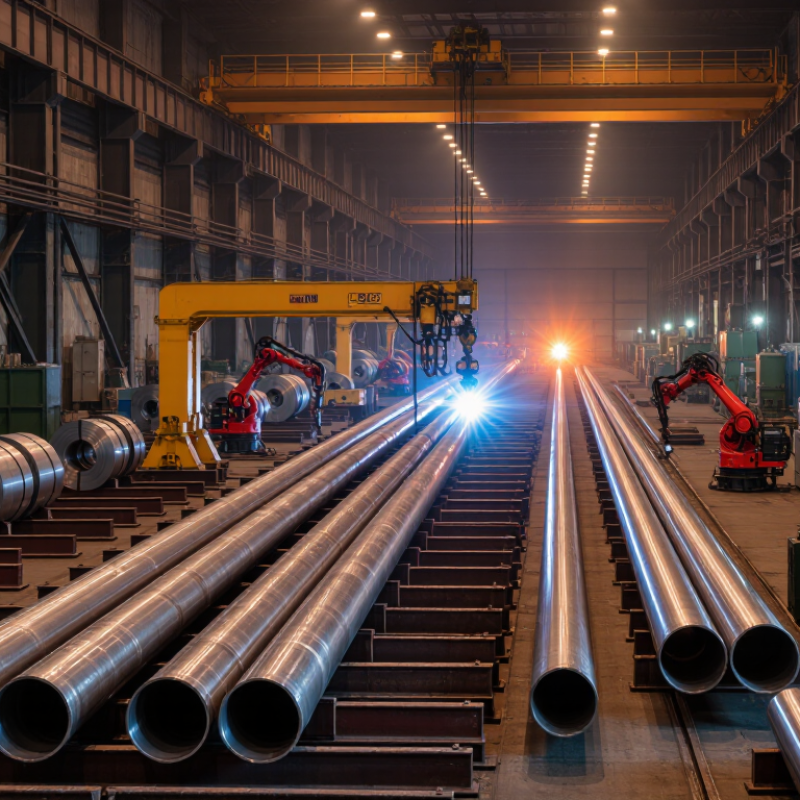
Top 10 Welded Steel Pipe Manufacturers Worldwide

Welded Steel Pipe: Definition, Types, and Global Applications

Welded steel pipe is made by forming steel plate or coil and joining its edges with heat or pressure. Unlike seamless pipe, it contains a visible weld zone that requires careful inspection. Common types include electric resistance welded pipe, longitudinal submerged arc welded pipe, and spiral welded pipe. Each type differs in diameter range, wall thickness, production speed, and suitable service conditions.

The choice is not merely a price decision. It depends on pressure, temperature, fluid chemistry, soil movement, and installation method.

ERW pipe is widely used for building columns, water lines, and lower-to-moderate pressure systems. Longitudinal welded pipe supports larger diameters and demanding transmission projects.

Spiral welded pipe can efficiently produce long, wide sections for water infrastructure, piling, and structural work.

In harsh environments, engineers may specify protective coatings, cathodic protection, or corrosion-resistant alloys. A coating can be scratched during transport.

Small damage can become a serious maintenance issue.

Reliable production combines controlled forming, qualified welding procedures, dimensional checks, and nondestructive testing. Ultrasonic or radiographic inspection can reveal incomplete fusion, cracks, and porosity. Hydrostatic testing may verify pressure resistance, while visual inspection checks the seam and pipe ends.

Details matter. Recognized standards define tolerances, test methods, and material grades, but project conditions still matter.

A certificate alone does not prove correct installation. Engineers should review traceability, weld records, coating condition, and site handling.

One detail is often missed: support spacing can create stress even when the pipe meets every requirement.

Is it perfect? Rarely.

Criteria for Ranking the Top 10 Welded Steel Pipe Manufacturers

Ranking the top ten welded steel pipe manufacturers requires more than comparing annual sales. The World Steel Association reported global crude steel production of about 1.89 billion tonnes in 2023. That scale makes production capacity useful, but not decisive. A credible ranking should measure verified welded-pipe output, mill utilization, product range, and delivery performance. Capacity alone can mislead.

Quality evidence deserves heavier weight. Audit records, dimensional consistency, hydrostatic testing, weld inspection, and compliance with recognized standards should be reviewed. ISO 9001 certification supports process control, while sector certifications show suitability for energy, construction, and water projects. The ranking should also examine nonconformance rates and customer warranty data. Fewer defects matter more than polished brochures.

Supply reliability is another practical filter. UN Comtrade data can help compare export reach, shipment value, and destination diversity. Financial reports should confirm investment in coating lines, automated welding, laboratories, and worker training. Environmental performance also matters: the International Energy Agency identifies steelmaking as a major industrial emissions source, so energy intensity and recycled content deserve measurable scores. No ranking is perfect. Published capacity may exceed real output, and private companies may disclose less data. A transparent scoring model should explain missing evidence, update results annually, and separate verified facts from informed judgment. Perhaps delivery stability should outrank impressive scale. That point remains debatable.

Profiles of the Top 10 Welded Steel Pipe Manufacturers Worldwide

Profiles of the Top 10 Welded Steel Pipe Manufacturers Worldwide

The first profile is a high-volume electric resistance welding mill serving water and construction projects. Its strengths include automated forming, online ultrasonic testing, and tight dimensional control.

The second profile focuses on spiral welded pipe for long-distance water systems. Large coil storage supports steady production, although transport planning remains a practical weakness.

A third manufacturer specializes in longitudinal submerged arc welding for thicker pipe walls. Its engineers often review weld penetration, bevel quality, and heat input.

The fourth profile combines pipe production with in-house steel slitting. This setup can improve material traceability and reduce scheduling delays.

The fifth manufacturer serves structural projects with coated welded pipe. It checks surface preparation, coating thickness, and holiday detection before shipment.

The sixth profile emphasizes small-diameter precision pipe for mechanical applications. Clean edges and consistent wall thickness matter greatly here.

The seventh producer operates near major ports and supports export orders. Its documentation team prepares inspection records, mill certificates, and packing details carefully. Still, port congestion can affect delivery promises.

The eighth profile supplies energy infrastructure and uses staged hydrostatic testing. Experienced technicians inspect weld seams before and after pressure testing.

The ninth manufacturer is known for flexible batch sizes and custom lengths. Its production planners respond well to changing project specifications. However, flexibility may increase setup time.

The tenth profile invests in lower-emission furnaces, water recycling, and digital production records. These measures strengthen environmental reporting and quality control.

Across all profiles, dependable manufacturers show verified testing, trained inspectors, clear traceability, and realistic delivery schedules. Buyers should examine recent audit records, not only impressive factory photographs. No profile is flawless. Performance depends on steel grade, pipe design, inspection depth, and site conditions.

Manufacturing Standards, Technologies, and Quality Control

Welded steel pipe manufacturers compete through consistent standards, advanced forming, and disciplined quality control. Their products may follow specifications such as API 5L, ASTM A53, or ASTM A500, depending on service requirements. Each standard defines grades, dimensions, testing, and acceptance criteria. However, certification alone does not guarantee reliable performance. Real control begins with verified steel coils, qualified welding procedures, and traceable production records.

Modern mills use electric resistance welding, high-frequency welding, or submerged arc welding for different pipe sizes and applications. Automated seam tracking helps maintain alignment. Online ultrasonic or eddy-current testing can detect hidden discontinuities during production. Hydrostatic testing then checks pressure resistance. Skilled inspectors still matter. Machines can miss unusual defects, especially when calibration, surface condition, or operator judgment is weak. No inspection system is perfect.

Tips: Request material certificates, weld procedure records, and recent inspection reports before purchasing. Confirm that test methods match the intended application. Ask how often instruments are calibrated. Check pipe ends, coating condition, markings, and dimensional tolerances during receiving inspection. Keep samples from each batch when practical. This creates useful evidence if questions arise later. Manufacturers should also review nonconformities instead of simply repairing them. A repaired seam may pass testing, yet repeated repairs can reveal deeper process instability. Continuous review remains necessary.

Top 10 Welded Steel Pipe Manufacturers Worldwide — Manufacturing Standards, Technologies, and Quality Control

Industry benchmark based on API 5L PSL 2 line-pipe strength grades. The chart compares minimum yield and tensile strength requirements commonly used in welded steel pipe manufacturing; it does not rank or disclose company-specific data.

Quality-control relevance: Higher-strength grades require tighter control of welding parameters, heat treatment, non-destructive testing, dimensional accuracy, and mechanical-property verification.

Global Market Position, Products, and Industry Outlook

The global welded steel pipe market is shaped by infrastructure spending, energy projects, water networks, and industrial construction. The leading ten manufacturers usually hold strong positions through production scale, regional distribution, and consistent quality control. However, market rankings change with demand, currency shifts, tariffs, and project cycles. A ranking is never perfectly stable.

Their product ranges commonly include longitudinally welded, spiral welded, and high-frequency welded pipes. Sizes may extend from compact water-service lines to large-diameter transmission pipes. Buyers also compare wall thickness, steel grade, coating systems, weld inspection, and pressure performance. Reliable producers document traceability from steel coil to finished pipe. That detail matters on a crowded construction site.

Industry outlook remains cautiously positive. Urban water upgrades and lower-carbon transport systems should support long-term demand. Energy projects may continue contributing, although their growth can vary sharply by region. Digital inspection, automated welding, and lower-emission manufacturing are becoming stronger competitive factors. Still, technology alone does not guarantee dependable delivery. Some manufacturers may overstate capacity, while customers may underestimate logistics, storage, or field-welding challenges. Careful audits, sample testing, and contract-based quality requirements remain practical safeguards. The strongest market position will likely belong to manufacturers that combine scale with transparent evidence, flexible products, and responsive technical service.