Accordian Closable

7 Best Robotic Grinding Machines for Global Buyers?

Robotic grinding is moving from a specialist automation choice to a practical investment for global manufacturers. The International Federation of Robotics reported 541,302 industrial robot installations worldwide in 2023. Its World Robotics 2024 report also recorded more than 4.28 million robots operating globally. These figures show a mature automation market, although grinding requires more than a standard robot arm.

Grinding creates uneven contact, abrasive wear, heat, dust, and visible surface variation. A suitable system must manage these details consistently. Force control can protect delicate edges. Vision systems can locate irregular castings. Proper extraction protects operators and improves finishing quality. The Occupational Safety and Health Administration identifies combustible dust and abrasive-wheel hazards as important workplace risks. Therefore, safety design deserves equal attention beside cycle time.

This guide reviews seven robotic grinding machines for global buyers. The comparison considers payload, reach, spindle performance, force sensing, programming, enclosure design, dust control, energy use, service support, and replacement-part availability. These criteria reflect practical purchasing experience, not only brochure specifications. International buyers should also examine local technical support and training capacity. A low purchase price can become expensive when commissioning takes weeks.

No ranking fits every factory. A compact cell may suit aluminum castings, while a heavier system may handle forged steel components. Some published market forecasts appear optimistic, and real results depend heavily on part geometry and operator skills. That limitation matters. The selected machines are evaluated as production tools, with attention to measurable performance and long-term reliability. Sources include the IFR World Robotics 2024 report, OSHA industrial safety guidance, and manufacturer technical documentation.
7 Best Robotic Grinding Machines for Global Buyers?

What Is a Robotic Grinding Machine and How Does It Work?

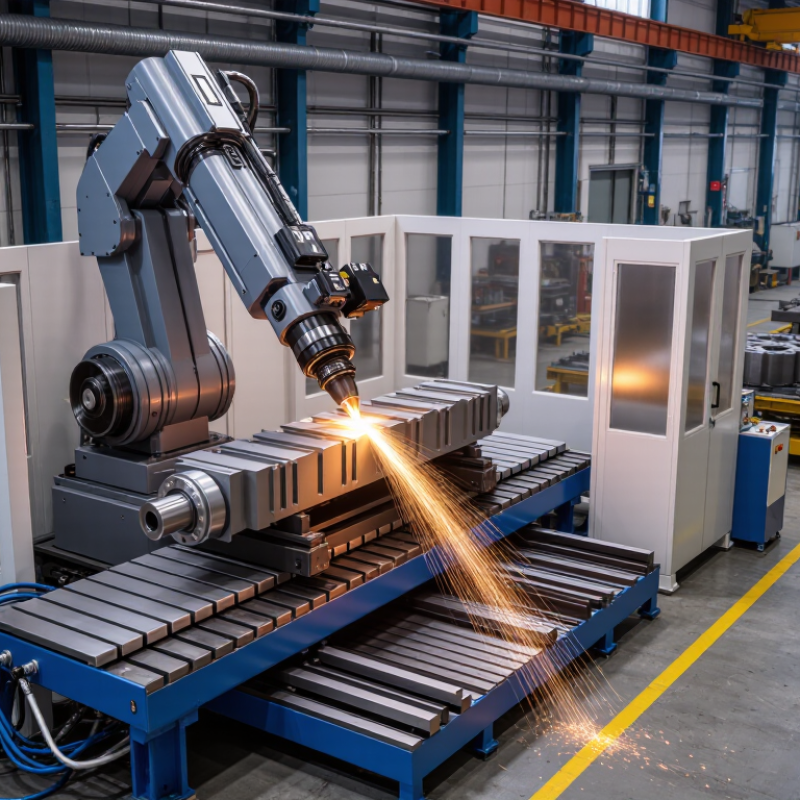
A robotic grinding machine combines an industrial robot, an abrasive tool, sensors, and control software. It removes burrs, weld spatter, sharp edges, or excess material from metal parts. It is not simply a robot holding a disc. The system must control contact pressure, travel speed, tool angle, and grinding time. A fixture holds each workpiece firmly, while a programmed path guides the robot around its surfaces. In demanding applications, force sensors help the tool follow uneven contours without cutting too deeply.

The process usually begins with a digital model or a taught path. An operator positions the robot, records key points, and sets grinding parameters. During production, sensors can detect part position, vibration, or changing contact force. The controller then adjusts movement in real time. Abrasive belts, wheels, or mounted points may be selected according to the material and required finish. Ventilation and dust collection are essential. Guards, interlocks, and emergency stops also protect nearby workers.

In practical use, the first program is rarely perfect. A small fixture error can leave an unground edge. Excessive pressure may create heat marks or shorten tool life. Experienced technicians check sample parts with gauges, visual inspection, and surface-finish measurements. They also review cycle data before increasing production speed. Robotic grinding improves consistency, but it still needs skilled setup and regular maintenance. That part is easy to underestimate.

Key Features to Compare in Robotic Grinding Systems

For global buyers, the best robotic grinding machine is rarely the fastest model. It is the system that maintains finish quality across changing parts. Compare payload, reach, spindle power, and abrasive compatibility first. A heavy arm may resist vibration, while a compact cell can reach narrow channels. Test cycle time with real castings, not polished samples. The International Federation of Robotics reported 541,302 industrial robot installations worldwide in 2023. Repeatability and service planning are now commercial priorities.

Check force control before brochure speed. The tool should maintain steady contact when a casting varies by several millimeters. Look for torque sensing, automatic path correction, quick-change tooling, and point-of-source dust extraction. Record wheel wear, heat marks, noise, and rework during an eight-hour trial. The International Labour Organization recommends structured risk assessment for machinery, so verify guarding, interlocks, emergency stops, and validated safety functions against local requirements. Safe integration beats impressive motion.

Software deserves equal scrutiny. A practical interface should import CAD paths, store recipes, and display clear alarms. Connectivity can track uptime, energy use, and abrasive costs. The U.S. Department of Energy identifies motor-driven systems as a major industrial electricity load, making spindle efficiency worth measuring. Do not trust every promised tolerance. Ask for sample data, calibration intervals, spare-part lead times, and support limits. Some cells still need manual deburring. That gap is easy to miss.

Seven Leading Robotic Grinding Machines for Global Buyers

Seven Leading Robotic Grinding Machines for Global Buyers

The seven strongest machine types include six-axis robots, collaborative grinding cells, gantry systems, dual-arm units, force-controlled machines, vision-guided cells, and wet-grinding systems. Each design solves a different production problem. Six-axis robots suit complex castings and changing angles. Gantry machines support large parts, while collaborative cells fit smaller workshops with limited floor space. Force control matters when pressure must remain steady across uneven surfaces.

The International Federation of Robotics reported 541,302 industrial robot installations worldwide in 2023. Its World Robotics 2024 report also recorded more than 4.28 million robots operating globally. These figures show expanding automation demand, but they do not guarantee a good grinding result. Buyers should inspect spindle power, abrasive compatibility, dust extraction, tool-change time, and programming support. A polished demonstration can hide costly maintenance.

Real production trials reveal more. Measure cycle time on actual castings, not perfect samples. Check edge quality after several hours of abrasive wear. Vision guidance can reduce repositioning errors, yet bright metal surfaces may confuse cameras. Wet grinding controls dust effectively, but it adds filtration and water-treatment duties. Safety design should align with applicable machine standards, including ISO 10218 and ISO/TS 15066 where relevant.

The ranking is not universal. Shop-floor dust still surprises experienced teams.

How to Match a Robotic Grinder to Your Production Needs

7 Best Robotic Grinding Machines for Global Buyers?

How to Match a Robotic Grinder to Your Production Needs

Choosing a robotic grinder starts with the part, not the machine catalog. Measure material hardness, weld size, surface condition, and required finish. A small aluminum casting needs different pressure control than a heavy steel frame. Record cycle time targets, too. A robot that removes a burr beautifully may still miss your daily output.

Look closely at access and repeatability. Complex curves may require a six-axis arm, force sensing, and automatic tool changes. Flat panels might need a simpler setup. Check payload, reach, fixture space, abrasive consumption, and dust extraction capacity. These details affect operating costs. They also affect worker safety and maintenance time. Keep the work area clean. Fine grinding dust travels farther than expected.

Ask the supplier for sample testing with your actual parts. Review finish measurements, tool wear, programming time, and recovery after a fault. A demonstration on a perfect sample proves little. In real production, castings vary, fixtures shift, and abrasive discs wear unevenly. I have seen teams choose excessive robot capacity and pay for unused performance. Others underestimated clamping needs and lost valuable hours. A practical pilot run exposes both mistakes. Leave room for manual adjustment, because full automation is not always the most reliable answer. Ensure training, spare parts, guarding, and local technical support are available before installation.

7 Best Robotic Grinding Machines for Global Buyers? - How to Match a Robotic Grinder to Your Production Needs

A practical comparison of common robotic grinding system configurations for different workpiece sizes, materials, production volumes, and automation requirements.

System Type Typical Workpieces Recommended Materials Robot Payload Working Reach Spindle / Tool Power Typical Throughput Key Automation Features Best Production Fit Buyer Priority
1. Six-Axis Belt-Grinding Cell Castings, weldments, forgings, brackets, and irregular profiles Carbon steel, stainless steel, aluminum, and ductile iron 20–50 kg 1.6–2.1 m 4–11 kW 25–80 parts/hour Automatic belt tracking, force control, tool change, part presence sensing High-mix production with variable contours ★★★★☆
Flexibility
2. Robotic Deburring and Edge-Rounding Cell Machined housings, valve bodies, gears, manifolds, and precision castings Aluminum, steel, brass, stainless steel, and engineering plastics 10–35 kg 1.4–1.8 m 1–5 kW 40–150 parts/hour Force-sensitive deburring, spindle speed control, automatic tool compensation Repeatable edge treatment after machining ★★★★★
Consistency
3. Heavy-Duty Robotic Grinding Cell Large castings, fabricated frames, construction components, and heavy forgings Carbon steel, alloy steel, stainless steel, and cast iron 50–150 kg 2.0–3.0 m 7.5–22 kW 5–30 parts/hour High-torque spindle, large abrasive wheels, fixture monitoring, dust extraction Large and heavy components with substantial stock removal ★★★★★
Removal rate
4. Robotic Polishing and Satin-Finishing Cell Sheet-metal panels, decorative hardware, kitchen components, and visible surfaces Stainless steel, aluminum, brass, copper, and coated metals 10–30 kg 1.3–2.0 m 2–7.5 kW 15–60 parts/hour Constant-force polishing, automatic compound application, finish inspection Cosmetic finishing where uniform appearance is critical ★★★★★
Surface quality
5. Dual-Station Robotic Grinding Cell Medium-sized castings, fittings, brackets, and automotive components Steel, aluminum, stainless steel, and nonferrous alloys 20–60 kg 1.7–2.2 m 4–15 kW 30–100 parts/hour Two-position indexing table, automatic loading and unloading, parallel processing Medium-to-high volume production with reduced idle time ★★★★★
Productivity
6. Vision-Guided Robotic Grinding Cell Mixed castings, randomly oriented parts, weld beads, and variable assemblies Steel, aluminum, stainless steel, cast iron, and mixed alloys 15–45 kg 1.5–2.4 m 3–11 kW 15–70 parts/hour 3D vision, automatic pose recognition, adaptive path correction, barcode tracking Unstructured feeding and frequent part variation ★★★★☆
Changeover reduction
7. Compact Collaborative Grinding Cell Small housings, tools, fittings, consumer hardware, and light fabricated parts Aluminum, mild steel, stainless steel, brass, and plastics 3–16 kg 0.8–1.3 m 0.5–3 kW 10–45 parts/hour Integrated safety monitoring, quick programming, manual load-assist mode Small batches, limited floor space, and frequent product changes ★★★★☆
Ease of deployment

Technical values are representative ranges for industrial robotic grinding configurations. Actual performance depends on workpiece geometry, abrasive selection, material hardness, fixture design, cycle-time targets, surface-finish requirements, and operator safety standards.

Global Purchasing Factors: Cost, Support, Safety, and Compliance

When comparing the seven best robotic grinding machines for global buyers, purchase price should not dominate the decision. A cheaper system may require imported tooling, longer commissioning, and expensive downtime. Calculate the total cost over five years, including abrasives, electricity, maintenance, programming, shipping, and operator training. Request a sample grinding test using your actual workpiece, alloy, surface allowance, and cycle target. A polished demonstration part can hide difficult production conditions.

Supplier support matters after installation. Ask how quickly engineers respond across your time zone, and check whether critical spare parts are available locally. Clear manuals, remote diagnostics, and structured training reduce dependence on one technician. Still, support promises can be vague. Put response times, training hours, and replacement-part availability into the contract.

Safety and compliance require careful local review. Confirm guarding, door interlocks, emergency stops, dust extraction, noise controls, and safe abrasive-change procedures. The robot cell should include a documented risk assessment, not only a safety label. Verify electrical requirements, machinery documentation, electromagnetic compatibility, and applicable standards in the destination country. A machine certified for one market may need additional assessment elsewhere. That detail is easy to miss. Ask for test records, declarations, and service procedures before payment, then have a qualified local professional review them.

7 Best Robotic Grinding Machines for Global Buyers

Indicative total acquisition cost ranges for common robotic grinding-cell configurations. Values are planning estimates in USD thousands, excluding taxes, building work, and final installation conditions.

Cost is only one purchasing factor. Global buyers should also compare local technical support, spare-parts availability, operator training, guarding, risk assessment, and compliance with applicable requirements such as ISO 10218, ISO 12100, ISO 13849, and IEC 60204-1.